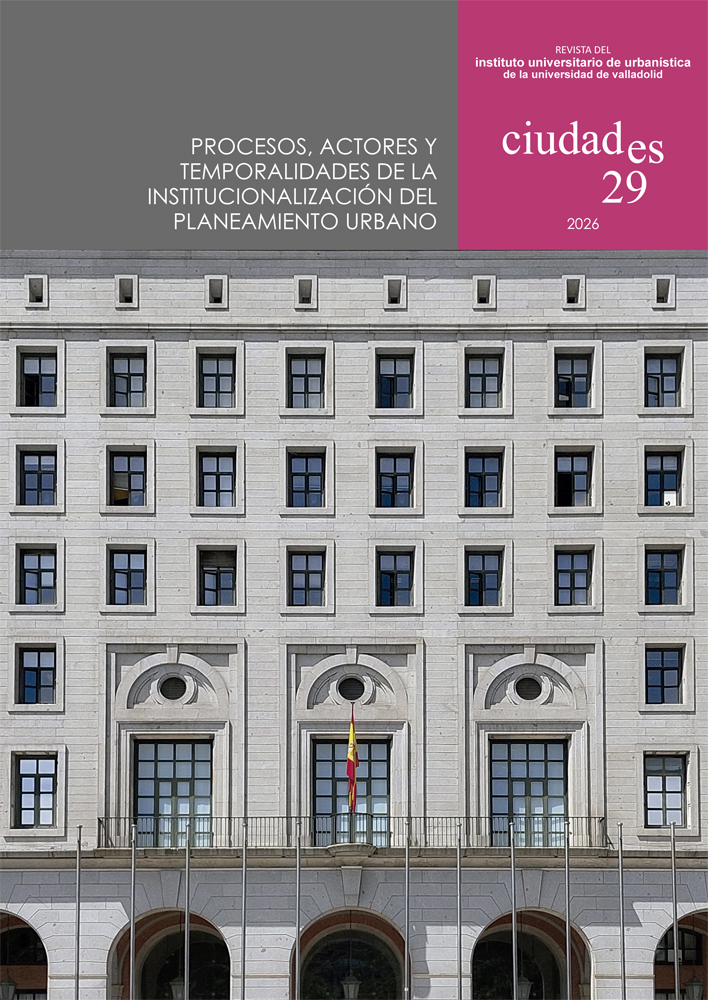
The publication of this issue 29 of the journal Ciudades coincides with the seventieth anniversary of the passing of the Act of 12 May 1956 on land use and urban planning, a milestone in contemporary Spanish urban planning, as it was the first comprehensive urban planning code, establishing principles and instruments for the systematic planning of the territory. It therefore represented a decisive step in the modernisation of urban planning legislation and the implementation of urban planning in Spain, something that had been aspired to since the early 20th century. Marking this anniversary, this issue examines the institutionalisation of urban planning, that is, the processes, actors and temporalities involved in the emergence, subsequent consolidation and implementation of the urban planning system established by the 1956 Land Law.
Not forgetting the developments prior to the Civil War (1936-39), notably the 1924 Municipal Statute and its Regulations on Municipal Works, Services and Assets, which recognised urban planning as a municipal responsibility and compiled the various instruments that had been regulated over the last third of the 19th century, the imposition of the Franco regime ushered in a new phase, initially one of practical, administrative and legal experimentation. Among other initiatives, the drafting and subsequent approval in 1946, through a special law, of the General Urban Plan for Madrid, and the simultaneous creation of a General Commission responsible for its management (a system replicated in parallel in Bilbao and Valencia), served as the basis for the 1956 Land Law, to which, very shortly afterwards, in 1957, was followed by the creation of the Ministry of Housing and the Directorate-General for Urban Planning, separated from the Directorate-General for Architecture, whilst in 1959 the Urban Development Agency was established as the body responsible for land development.
The six articles that compose the monographic section of this issue 29 of Ciudades build their arguments around this new institutionalised urban planning system (focusing on its political and technical context), each from a different perspective; taken together, they cover its various facets.
The first article, by Rodrigo Almonacid, examines the role of urban planning in the attempt to impose fascist ideology on Spain during the early years of the Franco regime; in other words, it focuses on the attempt to apply the ideological principles of ‘generic fascism’ (totalitarianism, ultra-nationalism and palingenesis) to urban planning, thereby turning it into an instrument at the service of the new state. In this regard, it examines the notions of hierarchy and the subordination of municipal planning to the national interest, the sources of inspiration and historical legitimisation of the new “organic” urban planning, and the role of urban planning in the “reconstruction” of Spain as expressions of a fascistisation which, nevertheless had a limited scope due to the pragmatic shift the regime underwent from the mid-1950s onwards, with urban planning being precisely one of its clearest manifestations. In fact, certain fundamental principles of the 1956 Land Law, such as the social function of property or the hierarchical structure of the planning system, bear some resemblance to Falangist ideology, although in practice they were systematically disregarded, with the acquiescence or even the more or less explicit contribution of the very bodies responsible for upholding them.
Next, Céline Vaz’s article addresses the professional practice of urban planning as reflected in the diploma in urban planning awarded by the Institute of Local Administration Studies (IEAL, established in 1940). In parallel with the institutionalisation of urban planning in its regulatory and administrative aspects, the IEAL and the studies it promoted from 1943 onwards played a key role in its consolidation and recognition as an autonomous technical discipline, breaking away from the links with urban administration and public health characteristic of pre-Civil War models, and addressing the limitations of urban planning education in architecture and engineering schools until the introduction of the 1957 and 1964 curricula. Furthermore, through an analysis of the students’ prior education, the subjects taught and the teaching staff, the article confirms that the diploma programme helped to consolidate the link between architecture and urban planning. Thus, the vast majority of both candidates and graduates were architects, who also taught most of the classes on a diploma programme which, whilst recognising the multidisciplinary nature of urban planning, clearly identified it with the practice of planning.
International influences also played a significant role in all these processes that contributed to the institutionalisation of urban planning in Spain; these were reflected in key aspects of the 1956 Land Law, such as the municipal planning system, in which the general plan and the partial plan have clear counterparts in the equivalent provisions of the 1942 Italian urban planning law. Furthermore, from the early 20th century onwards, several Spanish professionals were involved in international networks promoting urban planning, such as the International Federation for Housing and Town Planning (IFHTP). This significant issue is precisely the subject of the article by María Cristina García-González and Salvador Guerrero, which focuses on the Federation of Urban Planning and Housing (FUV), a private initiative promoted by César Cort, one of the leading figures in Spanish urban planning of this period. Specifically, the article focuses on the congresses organised by the FUV in Porto in 1951 and in Palma de Mallorca in 1954, which subsequently led to the establishment of World Urbanism Day in Spain. Both are interpreted as an expression of the institutionalisation of urban planning and of an incipient international opening through a limited transnational network which, in fact, failed to gain wider traction.
In addition to its origins and initial consolidation, institutionalisation can also be examined from a broader historical perspective, looking at how the urban planning system established by the 1956 Land Law has been maintained and updated to the present day, in line with political, economic and social developments. In this regard, it should be noted that the return to democracy following Franco’s death did not lead to a questioning of the legal framework and urban planning practices defined during his dictatorship, which have largely remained in place to this day. Indeed, the 1956 Land Law and its major reform passed in 1975 were a clear source of inspiration for the urban planning laws adopted by the Autonomous Communities in the 1990s and 2000s; consequently, many of the land-use planning regulations, procedures and practices they helped to establish remain in force, despite the passage of time and the succession of changes and reforms. This perspective, which spans the seventy years since the adoption of the 1956 Land Law and which connects directly with the present, is precisely what characterises the following two articles.
Felipe Iglesias’s article thus focuses on the planning execution provisions set out in the 1956 Land Law, analysing its basic characteristics and highlighting both its connection to the past (the proposals originally put forward by Ildefonso Cerdá) and to the present (its impact on current legislation), in order to critique the current urban management system, offering proposals for improvement that address the continuing dominant role of landowners and the scope of the concessions they are obliged to make. For its part, the article by Juan Antonio Lobato and Pedro Górgolas identifies and characterises three successive cycles of modification to the urban planning system established by the 1956 Land Law, all of which share the same deregulatory perspective: the concerted urban planning advocated by the 1975 reform, the land liberalisation proposed by the 1998 reform, and the current trends towards “simplification” and “flexibilization” observed in numerous amendments to regional urban planning laws. In this regard, they highlight the risk that the role of planning as the guiding instrument of urban and territorial policy, under the direction and control of the Administration, may be diluted.
Finally, the monographic section concludes with the article by Paolo Galuzzi and Marika Fior, which adopts the same historical perspective as the two previous texts, but applies it to another case that runs parallel to that of Spain and is of great interest: that of Italy. Starting from the aforementioned 1942 urban planning law, which, as noted, had a clear influence on the 1956 Land Law, the article traces the evolution of the Italian planning system through successive phases of reform up to the present day: from the “gradual reform” implemented in the 1960s and 1970s to the “urban federalism” resulting from the assumption of regulatory powers by the regions, in a process very similar to that which took place in Spain a few years later. With regard to the present day, the article raises issues similar to those currently at the centre of the debate in Spain, such as the obsolescence of the regulatory framework in relation to current challenges, or the excessive fragmentation and proliferation of sectoral regulations, linking this to the proposal put forward by the Istituto Nazionale di Urbanistica (INU) for a “framework law” at national level that envisages a “conceptual and regulatory overhaul” of territorial governance.
These last three articles demonstrate that, in a discipline as inherently forward-looking as urban planning, looking to the past is not merely about gaining a better understanding of history (its processes, its actors, its timeframes), which is valuable in itself, but also, on many occasions, stimulates useful reflections on the current state of urban planning. Comprehensive land-use planning and the provision of effective tools for this purpose led to the passing of the 1956 Land Law, which realised aspirations that had already been expressed previously and which remain fully relevant today. In this regard, the special section of this issue 29 of Ciudades has sought to contribute to rethinking urban planning from “the conviction of the need for planning” and “the idea that urban planning must be a public function at the service of all”, which constitute, in fact, the very ideology with which this journal identifies.
Alongside the six articles that make up the special section, this issue 29 also includes four articles in the miscellaneous section. The first of these, by Frățiman Andreea-Alexandra and José Ramón Sola, presents an interesting case set against the backdrop of the Cold War, specifically the influence of the CIA in the city of Brăila (Romania). Next, the article by Camilo Alejandro Moreno examines the social composition of central Bogotá, drawing on statistical sources that highlight processes of transformation. Meanwhile, the article by Carmen Blasco, Francisco Juan Martínez, Miguel Mansilla and Julia Cano offers updated perspectives on urban reform through two of the main avenues in the centre of Valencia, whilst the article by Hugo Capellà, Miquel Grimalt and Joan Bauzà proposes the notion of “urban duality” as an interpretative element linked to insularity, referring specifically to the island of Mallorca and three of its towns.
Finally, this issue is rounded off by the five reviews of recently published books included in the final section. The first two reviews share a common focus on the housing crisis, a highly topical issue in Spain and the subject of the works by Javier Burón (El problema de la vivienda: Cómo desactivar la bomba de relojería que amenaza con colapsar España) and Javier Gil (Generación inquilina. Un nuevo paradigma de vivienda para acabar con la desigualdad), reviewed respectively by Arturo Vicente and Julio César Arnaiz. Next, we include reviews by Nerea Morán of the book Barcellona/Madrid: un dialogo critico tra due città by Agustín Hernández Aja and Oriol Nel·lo; by Victoriano Sainz of the book Ceuta circa 1930: la construcción de la ciudad funcional by María Cristina García González and Salvador Guerrero; and by Guillermo Pavón of the book Manuel Trillo de Leyva. Obra completa 1964-2005, coordinated and edited by Amadeo Ramos Carranza and Valentín Trillo Martínez.
Alongside its usual role of introducing the contents of this issue, this editorial must on this occasion fulfil an additional function, in that this issue 29 marks the end of Luis Santos y Ganges’s tenure as director of the journal Ciudades, a role he took on in 2014, having previously served as managing editor since 2007 (and as a member of the Editorial Board since 2004). These have therefore been many years of fully committed and dedicated service to this journal, which have made its continuity and growth possible, ensuring that it continues today to fulfil the objectives for which it was founded in 1993, whilst successfully adapting to the requirements currently demanded of any scientific journal. Consequently, the journal’s Editorial Board, and the University Institute of Urbanism at the University of Valladolid as the publishing body, wish to express in this editorial their deepest gratitude to Luis Santos y Ganges for the excellent work he has carried out, in the firm belief that he has laid the foundations for this journal to look forward to a future that we hope will be long and fruitful.
Valladolid, May 2026





 Avda. Salamanca, 18 47014 · VALLADOLID (España)
  +34 983 184332
  iuu@uva.es