



new_icon_rewind new_icon_next

Small Towns Network

Description

Small towns are a global phenomenon. Since early times to the present day, a substantial part of the world’s population have resided in small towns and cities. Such communities remain important centres of economic and cultural activity as well as of regional integration. They function now as in the past at the interface of urban and rural society, they anchor the urban hierarchy, sustain metropolitan centres, and help underpin transnational urbanism. The role and future of small towns is highly relevant to the current public discourse on inequality, population decline and resilience.

Despite their importance, small towns and cities have been too often neglected in the older scientific literature. Recently however there has been new interest in the subject from social scientists and historians*. Still, there is a need for more comparative, interdisciplinary study, bringing together researchers from the Global North and South to examine key themes in small town development from the Middle Ages up to the present day from a transnational perspective.

The Small Towns Network was established at the EAUH Barcelona conference in September 2026. Membership is free. The purpose of the Network is to facilitate and promote comparative, transnational research on small towns and cities from the Middle Ages to the present, with a particular concern to stimulate interdisciplinary and global collaboration and cooperation between individuals and institutions:

by circulating news on researchers and their projects working in particular fields,
by circulating information on publications,
by encouraging and helping to promote session proposals for international conferences such as EAUH and Global UH Network . Also by reporting on conferences,
by supporting the development of joint projects.

We welcome information on researchers, projects, publications, conference proposals and conferences.

*Jerzy Bański, ed., The Routledge Handbook of Small Towns, 2022; Anne Lorentzen and Bas van Heur, eds., Cultural Political Economy of Small Cities, 2011; Paul Knox and Heike Mayer, eds., Small Town Sustainability: Economic, Social, and Environmental Innovation, 2009; Heike Mayer and Michela Lazzeroni, eds., A Research Agenda for Small and Medium-Sized Towns, 2022; Peter Clark, ed., Small Towns and Cities in World History, 2026.
Users Users

Committee

Peter Clark. University of Helsinki (Finland) [peter.clark@helsinki.fi] – Coordination
María A. Castrillo Romón. University of Valladolid (Spain) [maria.castrillo.romon@uva.es]
Katerina Chatzikonstantinou. University of Thessaly, Volos (Greece) [a.chatzikonstantinou@gmail.com]
Pierre-Henri Guittonneau. Centre Roland Mousnier UMR 8596 (France) [pierre-henri.guittonneau@hotmail.fr]
Matti Hannikainen. University of Helsinki (Finland) [matti.o.hannikainen@helsinki.fi]
Johan Lagae. University of Ghent (Belgium) [johan.lagae@ugent.be]
Lynn Hollen Lees. University of Pennsylvania (USA) [lhlees@history.upenn.edu]
Janset Shawash. Metropolia University of Applied Sciences, Helsinki (Finland) [janset.shawash@metropolia.fi]
Elena Svalduz. University of Padua (Italy) [elena.svalduz@unipd.it]
Katalin Szende. Central European University, Vienna (Austria) [szendek@ceu.edu]
Chong Xu. Soochow University (China) [chongxupku@gmail.com]

Partners

Instituto Universitario de Urbanística (IUU). University of Valladolid (Spain) [iuu@uva.es]

Institut für vergleichende Städtegeschichte (IStG). University of Münster (Germany) [istg@uni-muenster.de]

Directory of members

Aas, Steiner
Nord University, Bodø (Norway); steinar.aas@nord.no
Norwegian small towns, 19th-20th centuries

Balestreri, Isabella
Polytechnic University of Milan (Italy); isabella.balestreri@polimi.it
Civic architecture in the Italian small towns: history and archival heritage, 12th-20th centuries

Benyovsky Latin, Irena
Croatian Institute of History, Zagreb (Croatia); ibenyovsky@isp.hr
Medieval urban and social topography of the Eastern Adriatic (during Venetian rule)

Brêteau, Félix
University of Caen (France); felix.breteau@unicaen.fr
French cities, history of the police and criminal investigations [Villes françaises, histoire des polices et des enquêtes]

Brouard-Sala, Quentin
University of Angers (France); quentin.brouard-sala@univ-angers.fr
Small towns in Western Europe, social geography (memory, heritage, solidarity), 20th-21st centuries [Petites villes d’Europe de l’Ouest, géographie sociale (mémoire, patrimoine, solidarités), XXe-XXIe siècles]

Cadinu, Marco
University of Cagliari (Italy); cadinu@unica.it
Italian historic centres of medieval and modern origin

Carbonnet, Adrien
Sorbonne University (France); adriencarbonnet.sorbonne@gmail.com
Cities in the French-speaking world, relations between cities and the king, 15th century [Villes de l’espace francophone, rapports entre les villes et le roi, XVe siècle]

Castrillo Romón, María A.
University of Valladolid (Spain); maria.castrillo.romon@uva.es
Spanish small towns, urban planning and rural innovation, 19th-21st centuries

Chatzikonstantinou, Katerina
University of Thessaly, Volos (Greece); a.chatzikonstantinou@gmail.com
Greek small island towns, tourism and urban transformation, 19th-21st centuries

Chouin, Gérard
College of William & Mary, Virginia (USA); glchouin@wm.edu
Role of small and large towns played in building political identities in tropical Africa, particularly in the Gulf of Guinea, before and after the opening of the Atlantic trade

Clark, Peter
University of Helsinki (Finland); peter.clark@helsinki.fi
European/Global small towns

Davis, James
Queen’s University, Belfast (United Kingdom); james.davis@qub.ac.uk
Medieval English towns, markets and culture

De las Rivas Sanz, Juan Luis
University of Valladolid (Spain); jlrivas@uva.es
Spanish small towns, urban planning and heritage, 19th-21st centuries

Droste, Heiko
Stockholm University (Sweden); heiko.droste@historia.su.se
Nordic and German small towns

Drungilas, Jonas
Lithuanian Institute of History (Lithuania); jonas.drungilas@istorija.lt
Grand Duchy of Lithuania small towns, pre-modern period

Duroudier, Sylvestre
Panthéon-Sorbonne University (France); sylvestre.duroudier@univ-paris1.fr
French and American cities, geography, segregation, inequalities, mobility, 20th-21st centuries [Villes françaises et américaines, géographie, ségrégation, inégalités, mobilités, XXe-XXIe siècles]

News

November

1

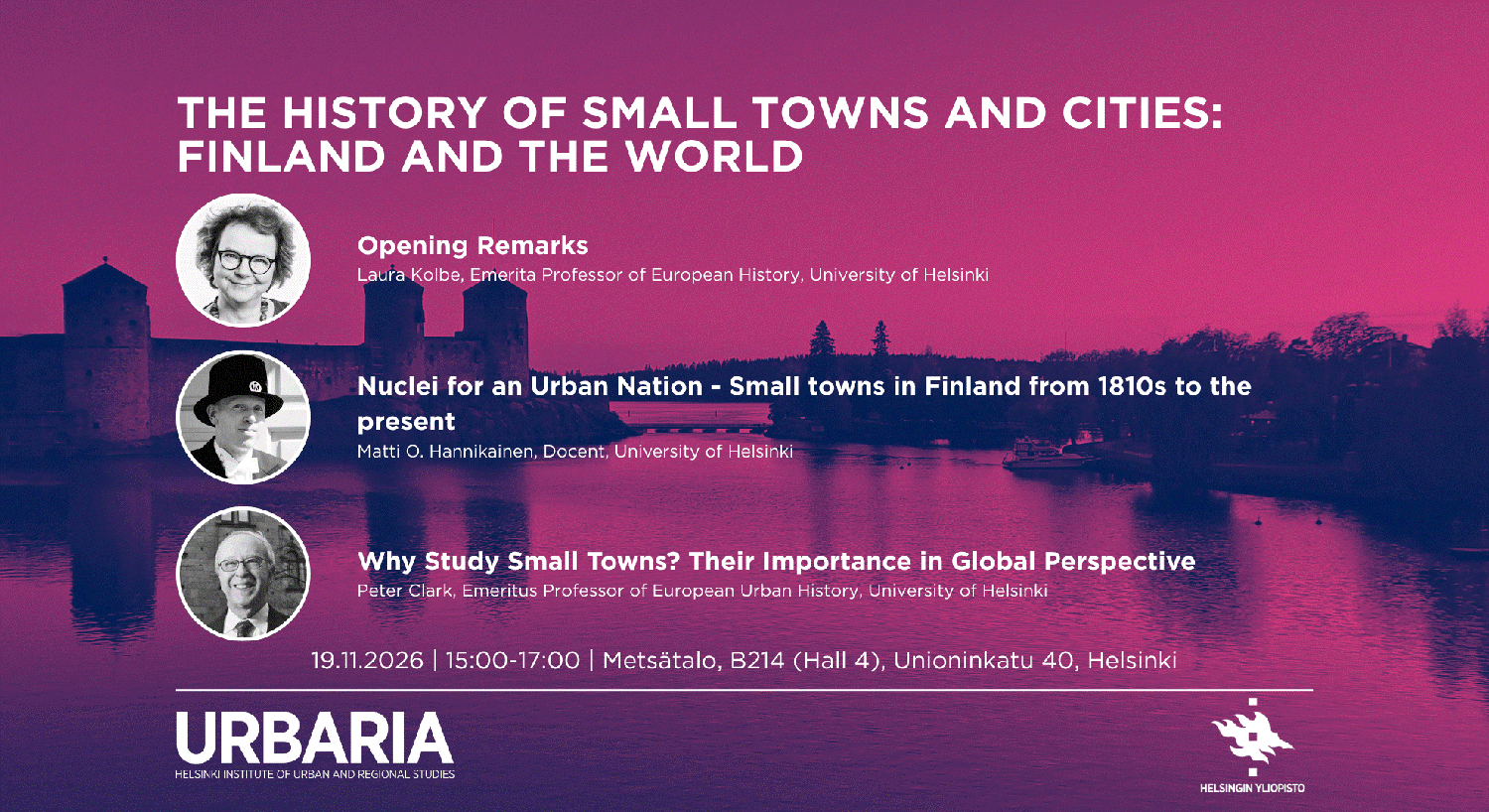
Urbaria Academics seminar: The History of Small Towns and Cities: Finland and The World!

Date: 19 November 2026
Time: 15.00-17.00
Place: B214 (Hall 4), Metsätalo, Unioninkatu 40, Helsinki

Programme:

Opening Remarks
Laura Kolbe, Emerita Professor of European History, University of Helsinki

Nuclei for an Urban Nation – Small towns in Finland from 1810s to the present
Matti O. Hannikainen, Docent, University of Helsinki

Abstract:
The last two centuries witnessed the gradual transition of Finland from an agrarian to an urban society. The advent of new industries coupled with new modes of transportation provided the momentum for economic growth for numerous smaller towns after the 1850s. The urbanization thus continued the tradition of a top-down urban policy and process to boost commerce, while new urbanizing communities grew up as local hubs for trade, industries, and transportation with local impetus from below. Yet most of the 37 Finnish towns in 1900 were small. Thew new century witnessed a profound societal change due to continuous population growth, however. While Finnish society urbanized, national policies did not support the process wholeheartedly. Until the 1960s, the aim of Finnish policies was to control urbanization, which partially explains the small size of many Finnish towns and townships. With accelerated urban growth after the Second World War, the creation of new towns after 1960 was seen as a way of regaining political control over the urbanization process and invigorating trade and industrial development across the country with limited success in longer perspective. Hence, at the advent of the 21st century, Finnish small towns remain a heterogenous group and their position is under pressure again.

Why Study Small Towns? Their Importance in Global Perspective
Peter Clark, Emeritus Professor of European Urban History, University of Helsinki

Abstract:
Too often neglected in the urban literature and public debate, small towns (from the Middle Ages to now) have housed a significant part of the urban population and played a key role in urban development, at the regional, national and global level. The recently published book by Emeritus Professor Peter Clark, Small Towns and Cities in World History (2026), sheds new and important light on their trajectory and multi-functionality up to the present day.

2

The IStG in Münster, Germany, is now a partner of the STN. It is a unique research hub aiding and supporting the wide range of interdisciplinary European urban studies. A large research library and the most comprehensive collection of Historic Towns Atlases feature among the resources we put at the disposal of visiting scholars. IStG publications and academic events frequently focus on small towns, town types, urban networks, and related issues. Check out our website on: https://www.uni-muenster.de/Staedtegeschichte/

October

1

Zora Piskacova co-organized a panel with Jana Hunter for the upcoming Association for Slavic, East European, and Eurasian Studies convention in November 2026. It explores four small towns in the Bohemian Lands and their relationships with the state.

2

Pablo Sánchez Pascual is currently organising two international conferences scheduled for 2027 in Zaragoza (Spain) and Genoa (Italy).

3

Gérard Chouin is currently co-director of the Ife-Sungbo Archaeological program, which studies the urban archaeologies of Ile-Ife in southwestern Nigeria during the second millennium CE.