Doctoral Programmes

History of European Urbanism in the 20th Century (urbanHist)

Data

Funded by: European Commission
Framework Programme: H2020-EU.1.3.1. – Fostering new skills by means of excellent initial training of researchers
Programme: Marie Skłodowska-Curie Actions – Innovative Training Networks – 2016
Code: 721933
Participants:
Bauhaus-Universität Weimar (Germany, Coordinator), Universidad de Valladolid (Spain), Univerzita Pavla Jozefa Šafárika v Košiciach (Slovakia) y Blekinge Tekniska Högskola (Sweden)
Start date: October 2016
End date: September 2020 (Extended until July 2021)
EU contribution: 3.703.651,56 Euros
EU contribution (Instituto Universitario de Urbanística): 991.491,84 Euros

Description

urbanHist, History of European Urbanism in 20th Century, is a European Joint Doctorate founded by European Union with almost 4 million Euros to be developed along 4 years by 4 universities: Bauhaus-Universität Weimar (Germany), Univerzita Pavla Jozefa Šafárika v Košiciach (Slovakia), Blekinge Tekniska Högskola (Sweden) and Universidad de Valladolid (Spain, through Instituto Universitario de Urbanística). Eleven partner organisations from Europe, Czech Republic, France, Germany, Italy, Slovakia, Spain, Sweden and United Kingdom are also taking part.

The expected results of urbanHist focus on the organization of a major program of research activities and scientific dissemination and on the development of 15 doctoral theses under a scheme of co-tutelage, all of them based on various aspects of the history of the development of European cities in 20th Century through urban planning.

urbanHist start point is that one main field of recent European history still awaits a comprehensive analysis: The history of Europe in the 20th century is – to a large extent – a history of urban planning. Even though it is essentially a shared history, full of mutual influences between European countries, it has mainly been perceived and presented fragmentarily until now.

urbanHist considers the history of urbanism in the 20th century to be a common European history, which must be cooperatively elaborated. So, urbanHist aims to:

    1. Strengthen the currently developing comprehensive European debate about urbanism in the 20th century with new content, which structures the historiography of urbanism,

    2. Educate a generation of researchers, who, as part of an innovative European programme, will have the best chances of become leading academics of a new European generation,

    3. Bring the participating beneficiaries and non-academic institutions together on a new level of sustainable internationalisation.

urbanHist uses works of experienced academics and experts of selected non-academic institutions as well as the innovative energy of early researchers to access an important chapter of shared European history.

Early Stage Researchers

The four posts of “Early Stage Researchers” (PhD students) that correspond to the University of Valladolid were awarded to Federico Camerin, Elvira Khairullina, Ksenija Krsmanovic y Noel Antonio Manzano Gómez. Below there is a brief summary of their CV and research.

Project: Urban Heritage Planning, its Relations to Real-Estate, Economic and Social Models in 20th Century Europe

Supervisors: Alfonso Álvarez Mora and Víctor Pérez Eguíluz (UVa) and Max Welch Guerra (BUW)

Academia.edu: https://uva-es.academia.edu/FedericoCamerin
Researchgate: https://www.researchgate.net/profile/Federico_Camerin
Google Scholar: https://scholar.google.it/citations?user=kftmKVsAAAAJ&hl=es


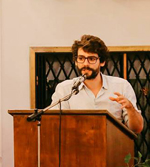
Federico Camerin (1989), city planner, obtained in 2014 an Inter-University-Programme Graduate Degree in “City and Environment: planning and policies” which included an European postgraduate degree in “Planning & policies for cities, environment and landscape” at Università IUAV di Venezia (Italy). He was awarded two fellow research in “Urban planning” at the Dept. of Design and Planning in Complex Environments of IUAV University of Venice (2014-15 and 2016-17). From April 2017 he is a Ph.D. student and Early Stage Researcher in the frame of European Programme UrbanHist between the Instituto Universitario de Urbanística of University UVA of Valladolid (Spain) and the Fakultät Architektur und Urbanistik of Bauhaus-Universität Weimar (Germany).

His doctoral thesis focuses on the role of the so-called ‘great property’ in the European city-making process in the last third of the 20th century, taking as a specific reference military properties. This implies the understanding the ‘great property’ as ‘fixed capital in land’ responsible of the city-making process by means of the interrelation of three processes involving such great properties: materialisation-construction, dismantling-abandonment-emptying, and regeneration.

Among his international experience, in 2013 he took a 3-month period of Erasmus Placement at Dept. of Geography, UAB Autonomous University of Barcelona (Spain), and between 2018 and 2019 he had 3-month secondment both at the Center of Social and Psychological Sciences Institute of Social Sciences (Košice, Slovak Republic) and the Colegio Oficial de Arquitectos de Madrid (Spain) under urbanHist programme.

Camerin’s research interests center on the understanding of the European city-making process on the ground of several aspects: the dismissal-regeneration of military assets, the urban regeneration process, and the great events and urban transformation, and the role of stararchitects in the management all of them at European level. He held several lessons in European countries (Germany, Italy, Slovak Republic, Czech Republic, and Spain), and he attended more than 20 national and international conference, plus publishing 40 papers among international and national journals, and conference proceedings.

This project has received funding from the European Union’s Horizon 2020 research and innovation programme under the Marie Skłodowska-Curie grant agreement No 721933